Undergrad Scholarships
Crossing Continents to Connect with the Science Community
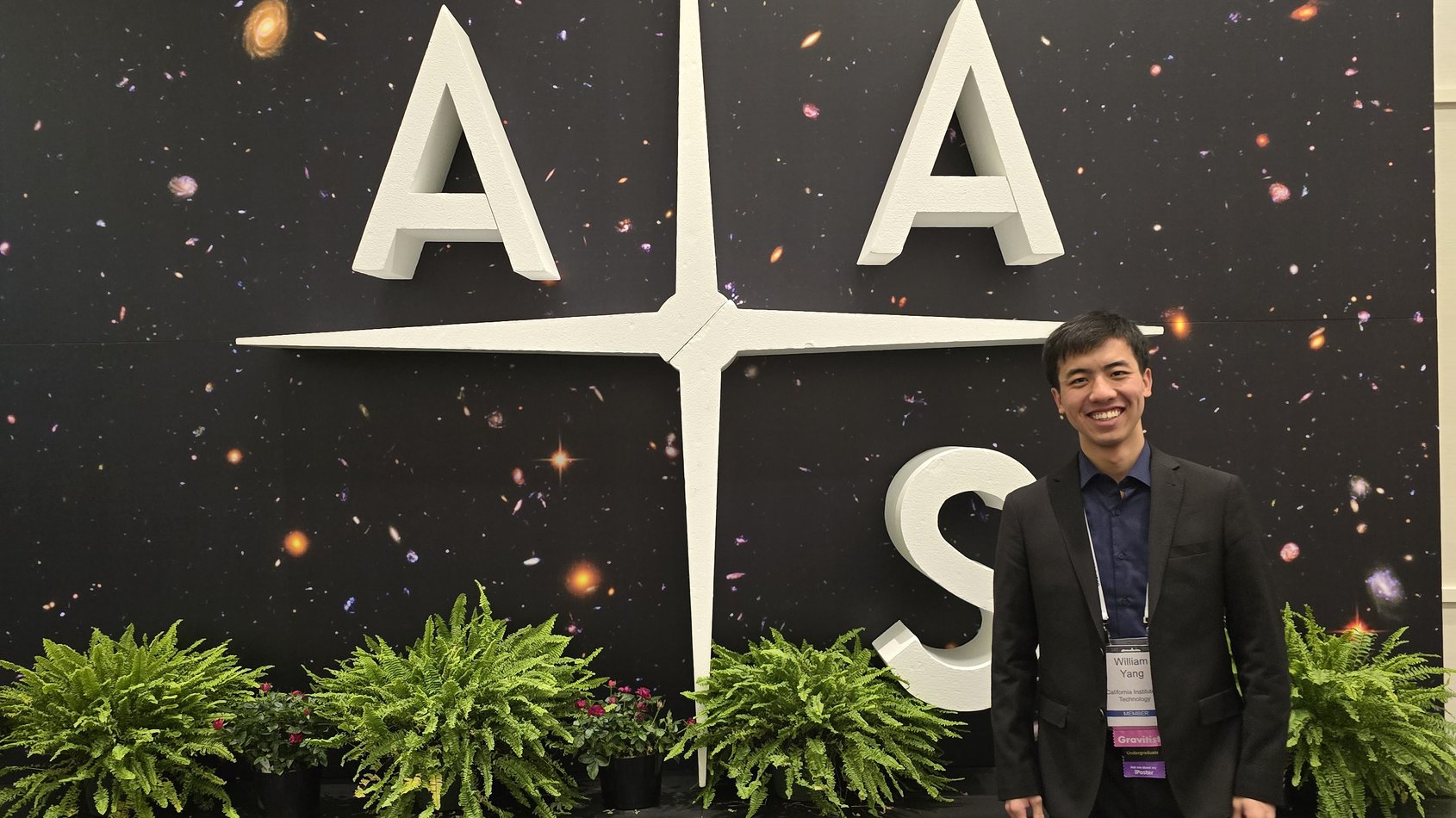
Just halfway through a bachelor's degree in physics, William Yang has presented his black hole research in Washington, D.C., and is studying abroad at Cambridge—demonstrating the international impact of Caltech scholarships.
During the last transit of Venus, in 2012, William Yang was a primary school student in Sydney, Australia. He watched in awe as the planet passed in front of the sun, a dark circle sliding steadily across a star. That rare celestial event set him on a trajectory toward astrophysics across the globe.
"It made me want to understand what the earth and the universe were made of," says Yang. "I knew that finding those answers was something I wanted to do for the rest of my life."
He's well on his way. As a third-year physics student, he's making career connections across the international astrophysics community made possible by undergraduate scholarships.
Yang describes being accepted to Caltech as "surreal." He and his parents were excited but also knew that attending a school 7,500 miles from home was going to be a logistical and financial challenge. "Going to university in Australia is heavily subsidized, especially for a local resident. It's orders of magnitude less than the cost in the US," he says. Although they hadn't been preparing for the cost, they didn't want to miss the opportunity.
"When we received the financial aid letter, it was as exciting as getting the acceptance letter from Caltech," adds Yang. "The scholarships I've received have allowed me to attend my dream school and opened up the world of advanced research."
Diving Right into Research
The Institute's First-Year Seminar program helped propel Yang into research. These courses encourage curiosity and connection with faculty on topics ranging from quantum information science to earthquakes in intimate groups of 10 to 15 students.
"One of the things that really made me fall in love with Caltech after I got here was a First-Year Seminar on gravitational waves and LIGO," says Yang, referring to the Laser Interferometer Gravitational-wave Observatory, a "black hole hunting machine" supported by the National Science Foundation and operated by the Institute and MIT. "Gravitational waves and black holes are a booming area of research that Caltech has the infrastructure to investigate."
Yang was eager to conduct research but felt intimidated at first. Professor of Physics Alan Weinstein encouraged him to dive right in. Soon he was in a study group with supportive postdoctoral students.
"They broke down the barriers to entry as a first-year student, made me feel like I was welcome, and reassured me that Caltech was a place for undergraduate research."
Networking, Presenting, and Publishing
After his first year, Yang participated in the Summer Undergraduate Research Fellowships (SURF) program, conducting research with postdoctoral scholar Kyle Kremer at Caltech and the Carnegie Observatories adjacent to campus. Using cutting-edge simulations, they investigated the behavior of black holes in globular clusters. The success of that research led to Yang presenting at the Jet Propulsion Laboratory, managed by Caltech for NASA, and in Washington, D.C., at the conference of the American Astronomical Society. That project is still going, with a publication in the works.
"Everyone was very encouraging, and many of the scientists at that conference have reached out to me with their insights and projects," says Yang. "Science is inherently collaborative, so having this opportunity to be immersed in your field and meet potential collaborators is amazing."
Yang followed that success with another SURF after his second year. This time he was looking for dark matter using pulsar timing arrays, which are traditionally used to observe gravitational waves. He credits that research with giving him the opportunity to apply many of the advanced mathematical techniques he learned in Caltech courses.
Resonating with the Science of Music
When he isn't studying phenomena like the ringdown of gravitational waves when black holes collide, Yang is performing in the Caltech Orchestra and chamber music ensembles. Piano and cello have been an important part of his life since an early age. The inspiration to play at Caltech came from another First-Year Seminar, The Science of Music with Hugh David Politzer, the Richard Chace Tolman Professor of Theoretical Physics and a Nobel Laureate in physics.
"I never expected to be in a class with somebody who's won a Nobel Prize in my first year! To be able to chat with him during and after class blew my mind," says Yang. "I'm a big fan of the First-Year Seminars!"
Yang was similarly starstruck when he joined the orchestra and discovered that the director was the globally renowned Glenn D. Price. In addition to serving as the Institute's director of Performing and Visual Arts, Price has taught and conducted around the world.
The budding musician also expresses gratitude to donors who have allowed him to balance his academics with his passion for the arts. "They've made it possible for students like me to pursue both our academic and personal passions without the financial burden, and for that, I'm incredibly grateful."
Opening Up a World of Discovery
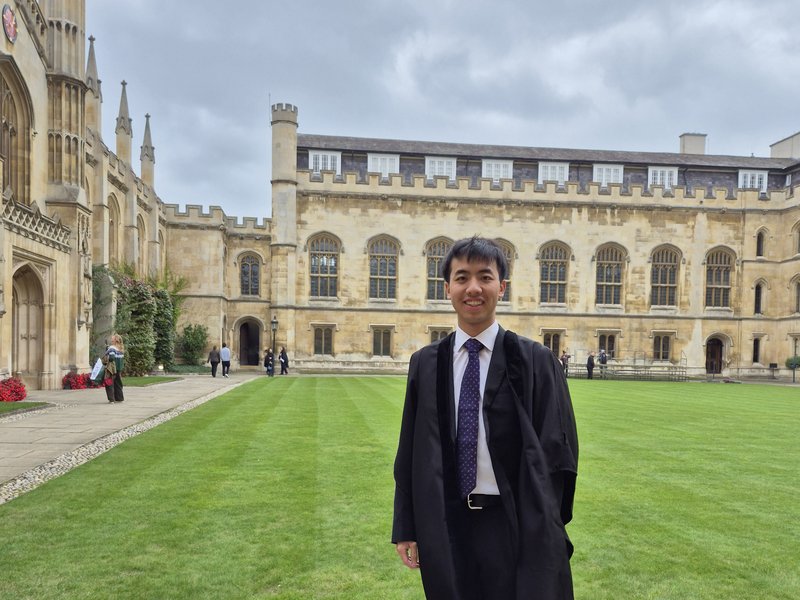
Yang started his third year by studying abroad at the University of Cambridge. Not only was it the home of his childhood hero Stephen Hawking, it offered an opportunity to learn how science is conducted on a third continent. He's particularly excited about taking a course on relativistic astrophysics and cosmology. One of his Caltech professors took that same course when he was at Cambridge and uses it as a model for his own teaching.
And as he embraces experiences that have led him from Australia to the United Kingdom, Yang looks forward to returning to Caltech to complete his undergraduate degree. "Coming to Caltech has been one of the most transformative experiences of my life," he says. "I've had the chance to meet so many amazing people from world-class professors and instructors to peers who are all incredibly passionate, driven, and curious. Every day at Caltech, I know I will learn something new."