Undergrad Scholarships
Family Scholarship Helps to Level the Field for Others
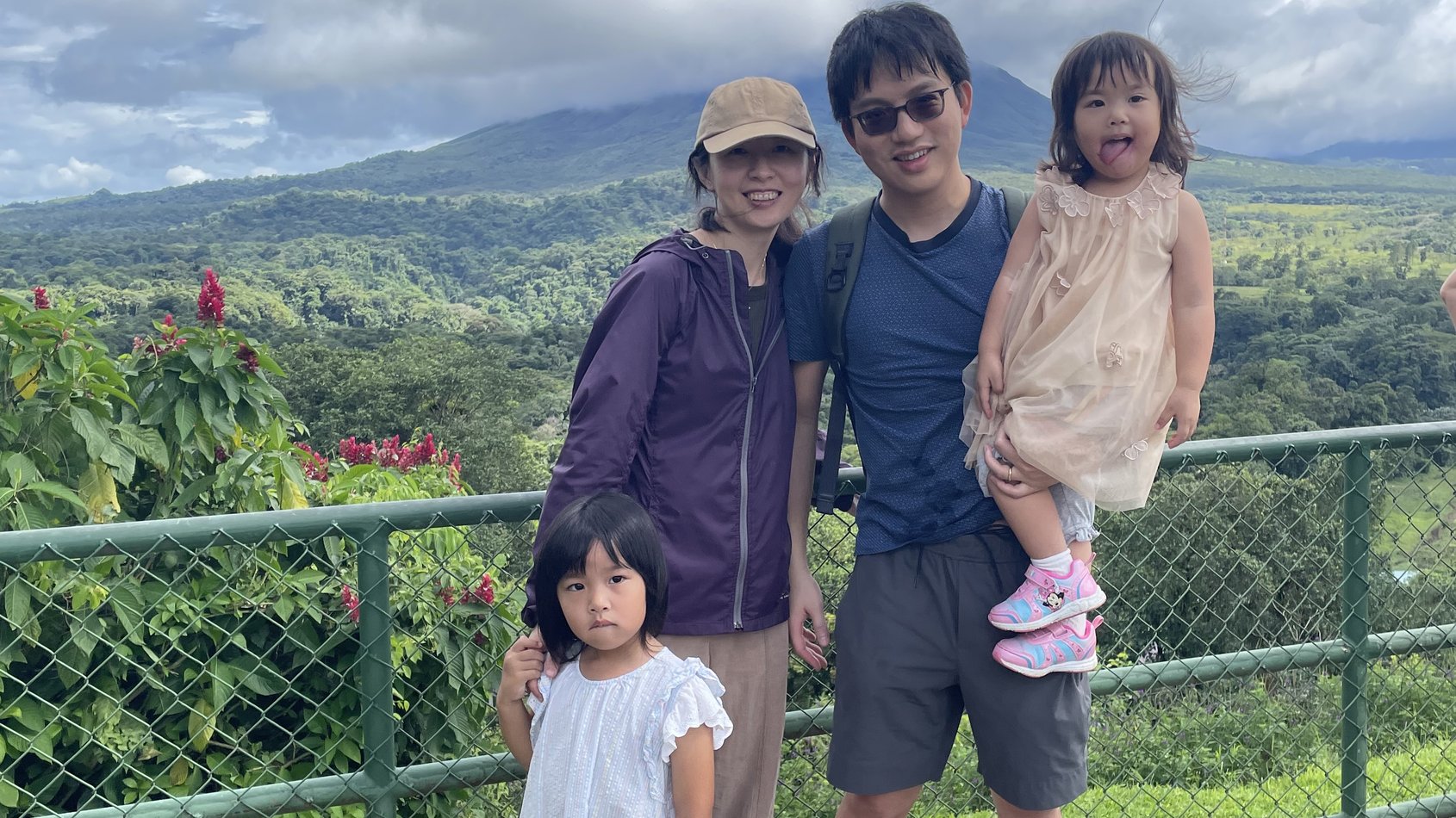
For Xiangyi Huang (BS ’15) and his wife Helin Gao, meaningful connection with Caltech alumni, faculty, and leadership helped them decide to establish an endowed family scholarship.
Growing up in Wuhan, China, Xiangyi Huang was immersed in college life as a child of a university professor. He would begin his own collegiate journey at Peking University. When several of Huang’s friends transferred to the United States to continue their studies, including his best friend who transferred to the Massachusetts Institute of Technology, Huang decided to join his peers and apply to American schools.
"I was very lucky to be accepted by Caltech," Huang says. "I didn’t expect how quickly I would be absorbed into the community. I joined Avery House and made many long-lasting friendships built on lots of late-night collaboration on problem sets." He cites the Institute’s walkable campus and small class sizes as key to that quick feeling of acceptance. The faculty-to-student ratio and project-based assignments also helped foster his connection with other students.
Just a little over a decade after graduating with three degrees in applied and computational mathematics, mathematics, and business, economics, and management, Huang has chosen to support other international undergraduates. Along with his wife, Helin, he has established the Xiangyi Huang and Helin Gao Family Scholarship providing funding for students with demonstrated financial need, with a preference for students who have resided or studied internationally.
“My hope is that students who have ambition and a drive to succeed have the opportunity to do so, and are not limited by where they came from," Gao says. "I hope the scholarship can level the field for young people."
Pursuing a Rewarding Career and Growing a Network
"One of the faculty that left a long-lasting impact on me was my undergraduate advisor, Yizhao (Thomas) Hou," Huang says. "Each quarter, he would update us on the progress that his team had made regarding the Navier–Stokes Equation, even though I understood little of the technical details. It showed me what it means to find something you’re passionate about." The Navier-Stokes Equation is one of seven Millennium Prize Problems by the Clay Mathematics Institute that features a million dollar reward for a proven solution.
After graduating, Huang moved into quantitative finance working as a researcher focused on applying data-driven approaches to financial market problems.
"I would compare it to physics, how we break down real-world problems," he says. "We model first and second order effects that can explain a phenomenon, then predict future market outcomes from a diverse set of inputs using quantitative approaches."
The rise of machine learning has accelerated much of his work, with AI playing a larger role in the iteration and feedback loop around his modeling.
"Caltech prepared me to be open minded and understand the latest advances in AI," Huang says. "While the nature of the problems remain the same, with AI we can run more ideas and explore larger datasets. It’s a very rewarding research experience."
Now a research lead at his firm, Huang credits the intelligence and success of his colleagues as why he chose to work there. "Even now, I benefit from the alumni network, engaging with Caltech alumni every day at work. I am surrounded by people who are smarter than me," Huang says. "I hope to continue networking with current students, especially those considering careers in quantitative finance."
Traveling with the Caltech Community: From the Galápagos to Iceland
Huang and Gao connected at her alma mater, Stanford University, through mutual friends. "He turned out to be the perfect match," Gao says with a laugh, noting that they share a deep intellectual curiosity and a similar way of thinking. "Intellectual curiosity excites me the most," she adds when explaining her choice of career. "There aren’t many careers that truly connect with what you learn in school, but quantitative finance is a perfect fit for my skill set."
In 2024, Huang and Gao embraced their shared curiosity when they received an invitation from the Caltech Alumni Association to attend a trip to the Galápagos Islands with the Caltech Associates, a philanthropic organization that supports the Institute's mission and which recently celebrated its centennial anniversary. The couple brought their then three-year-old daughter with them to see the islands’ unique wildlife and geology. Faculty offered daily research seminars in biology, genetics, and chemistry.
"It felt like I was back at Caltech, surrounded by people who genuinely love science and are passionate about research," Huang says. "I connected with professors, leaders, and trustees as well as President Rosenbaum. It made me realize how deeply Caltech stayed with me and inspired me to give back."
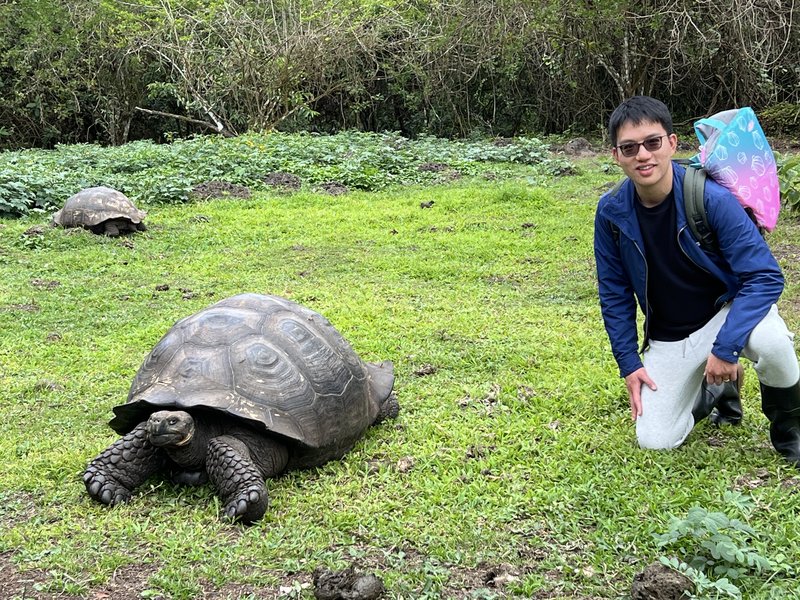
Huang with a giant tortoise on the Galápagos Islands.
Huang offers concrete advice for young alumni who might be considering giving back: join him on Associates trips.
"These are fantastic trips to spend more time with alumni and friends of Caltech," Huang says. "Being in that environment again refreshes your memory of school, and you’ll give back for those beautiful memories. I learn from the wisdom of professors and trustees, reconnecting with them every year and hearing their stories, as well as sharing my story."
Huang and Gao will be joining the Associates trip to Iceland and Greenland this June. They hope to go on these excursions whenever their children’s school schedules permit and give their growing family the opportunity to explore nature around the world with the Institute’s community.
"I enjoy meeting all the Caltech people," Gao says. "And I really hope this gift encourages more young alumni to contribute to the Institute."