Graduate Fellowships
A Graduate Fellowship Helps Give EAS Student the Freedom to Find his Driving Passion
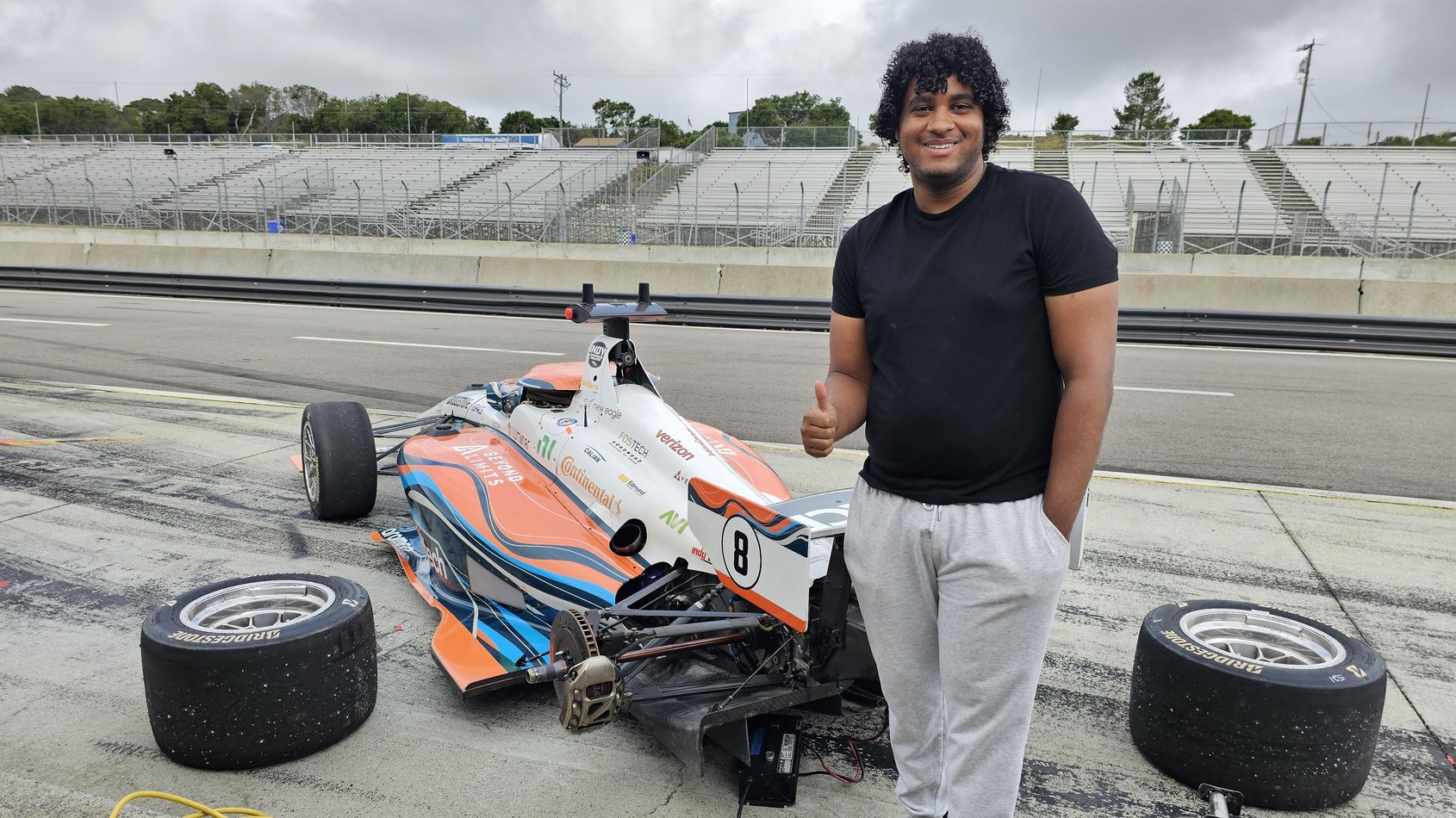
As an undergraduate at the University of Virginia (UVA), Gilchrist Johnson was struck by a car in a hit-and-run incident. That experience left him with an injured knee and a nagging question: What if cars could stop themselves or think on their own? Could that prevent accidents?
Now a second-year graduate student in the Division of Engineering and Applied Science, Johnson has turned that nascent interest into a research focus on autonomous vehicles, working in the lab of Bren Professor of Control and Dynamical Systems Soon-Jo Chung.
With support from the David and Catherine Thompson Graduate Fellowship Fund for Space Studies, Johnson was able to spend his first year at Caltech exploring and developing his interests without financial pressures or having to worry about immediately producing research.
"Having that freedom meant everything for me," says Johnson, who had transferred to UVA from community college and found his way to science and engineering relatively late as a student. "Had I attended another school and been expected to produce the caliber of research I’m doing now without that year to learn the theory, I might not have been as successful."
Balancing Safety and Speed
Johnson took the time to develop his skills as a mathematician and to immerse himself in the world of autonomous racing. With Chung’s invitation, he joined Caltech’s team for the Indy Autonomous Challenge, where universities from around the world compete in races as a way of advancing automated vehicle technology.
Using what he learned during his first year, Johnson is now carrying out research in the areas of simulation and multi-vehicle planning. Fortunately, he had some prior experience with the latter, having modified a platoon of golf carts at UVA for use as an autonomous linked system for campus tours.
Applying what he learned with the golf carts—slow-moving vehicles navigating a predictable space—to high-speed racing still has been a bracing challenge. "Finding safety-aware control schemes in a racing environment is much more difficult, much more intense," explains Johnson. "What would be a slight bump at golf cart speed would have the cars crashing or flying off the track at the speed IndyCar runs at."
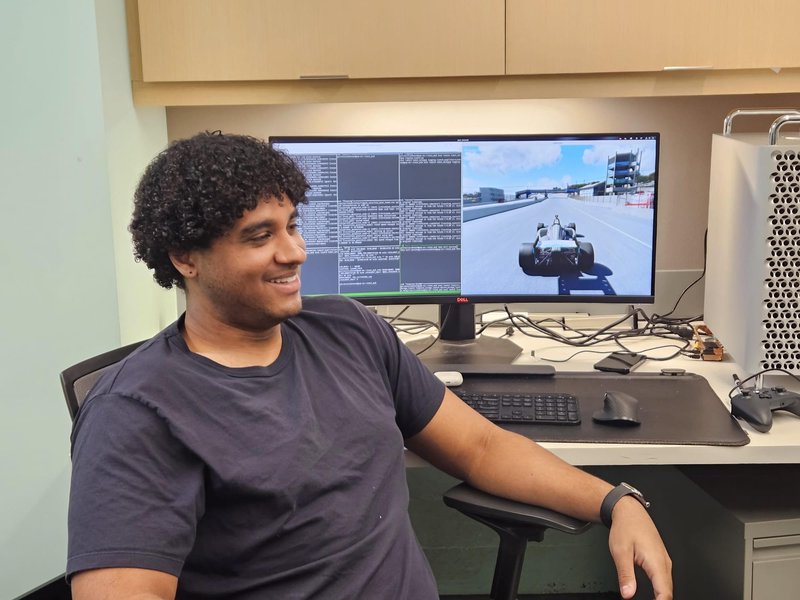
He has also been developing simulators to test out algorithms for his team’s autonomous cars. For one simulator, Johnson wrote all the code from scratch and for another he modified a popular high-fidelity driving simulator to run his control stack within the game. "We can test our car against other players and collect data to develop new strategies," he says.
Leveraging Autonomous Systems for Disaster Response
High-speed decision making is a challenging problem, and one that extends far beyond autonomous racing, according to Johnson. He plans to apply his Caltech research to create safer real-world transportation environments as well as to develop high-speed, safety-critical responses for disaster areas.
For Johnson, his interest in disaster response is personal.
His brother is what is known as a hotshot, a firefighter trained to tackle the most dangerous fires in remote areas. "We often discuss the challenges his colleagues face in these rapid-response, very high-stress environments," says Johnson. "Finding a way to deploy autonomous systems would save a lot of lives and make those environments much safer for the responders."
Helping Others to Find Their Path
Beyond his specific research focus, Johnson, who worked with teachers to improve K-12 STEM education as an undergraduate researcher at UVA, knows he wants to continue to be an educator and guide students on their academic journeys. His background, with its financial hardships and transitions from community college to a large public university to Caltech, gives him a particular perspective, he says, that he hopes can be useful to others.
With that in mind, he became involved early on with the Institute's Graduate Student Council and is now (with fellow EAS student Jedidiah Alindogan) co-chair of the Academics Committee. "It’s exciting," he says, "because we’re working with students and professors to figure out how we can serve both of these populations best."
One event sponsored by the committee, the Everhart Lecture Series, gives graduate students a platform to share recent research with the community as a way to spark interdisciplinary dialogue. It’s an opportunity, says Johnson, for students to ask questions like, "How can I leverage my knowledge as a roboticist with yours as a geologist, a chemist, a mathematician?"
Johnson and Alindogan also host a "Take a Professor to Lunch" series, which aims to make talking with distinguished professors less daunting. "Our message is 'Hey, it's just us chatting, having lunch. Ask whatever you want. These people are here to communicate with you,'" says Johnson.
In his role as resident associate for Lloyd House, Johnson also helps Caltech undergraduates deal with academic pressure and navigate emotional challenges. He encourages them to explore and take advantage of everything the Institute has to offer, reminding them that they are in an environment where students and faculty are willing to share their knowledge.
"My hope is that I can draw on my own experiences to help the undergraduate students of Lloyd and, later, the students I will mentor as a professor," says Johnson. "I want to inspire them to find their own paths, explore their ideas, and go on to help others."