Co-Curricular Experience
Honoring the Mentor Who Shaped Students into Scientists
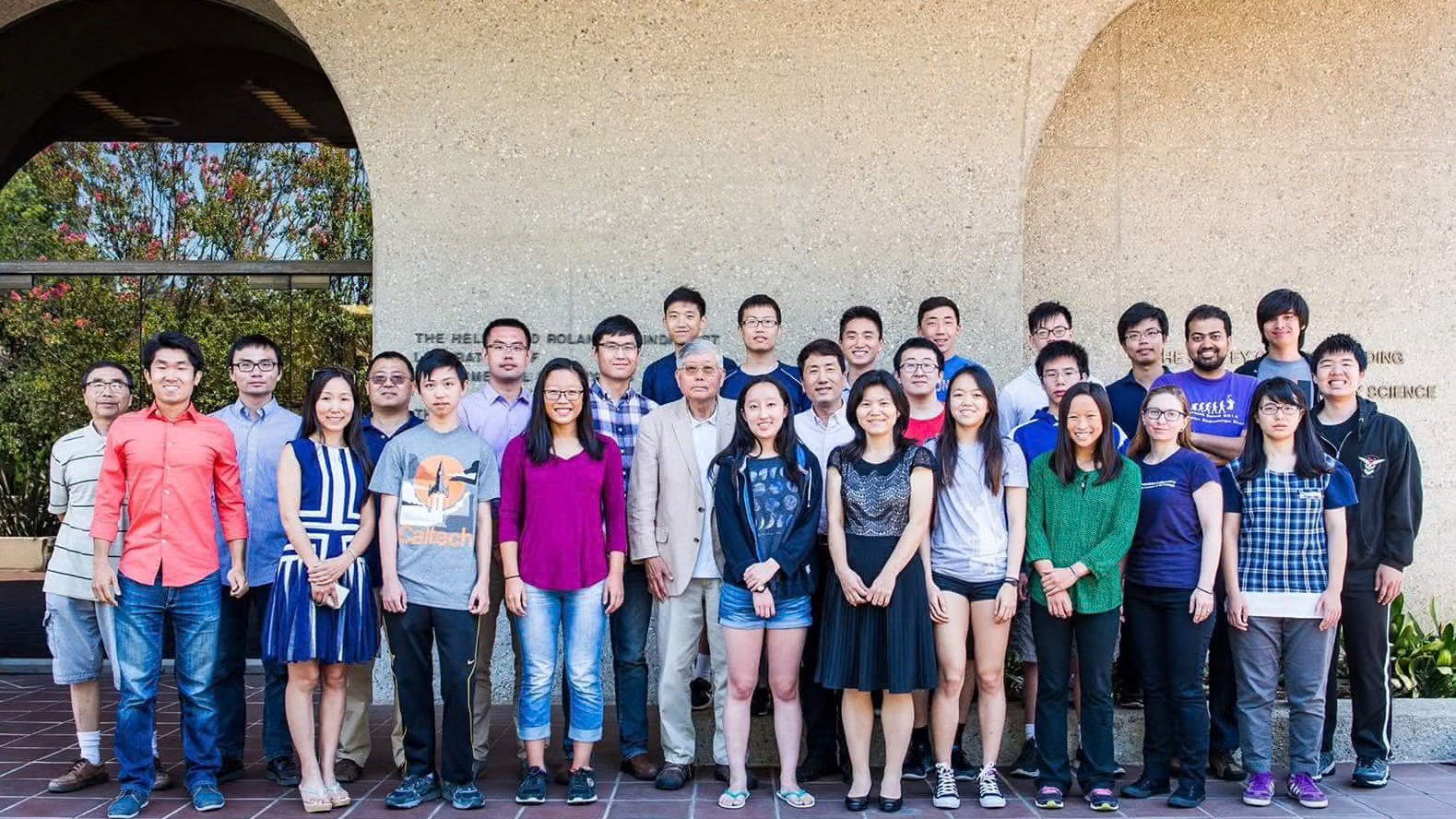
Yuk Yung (pictured center) surrounded by students and colleagues who playfully call themselves the “Yuk Army”.
During his 48-year career at Caltech, the late Yuk L. Yung sparked a passion for science in young people. A gift to support undergraduate researchers commemorates his legacy.
The late professor of planetary science and JPL senior research scientist Yuk L. Yung dedicated his career to revealing the composition and evolution of solar system atmospheres, including the changing chemistry of Earth’s climate. He was equally devoted to his student scholars, who playfully called themselves the Yuk Army. Together, they bridged differences in age, experience, and background to turn teamwork into discovery.
"Everyone was welcome in his group," says wife Shau May Yung of her husband who passed last March after a brief illness. "You could be a high school student with no research experience, and he would say, 'Come in, come in.' He would talk to them, figure out their talents, and find a way to help them."
To commemorate Yung’s lasting impact on young researchers, Shau May, her daughter Wing Ning Taketa (BS ’07), and son Wing Chi Yung have established the Yuk L. Yung SURF. The endowed fund covers the stipend awarded to a participant in the Summer Undergraduate Research Fellowships (SURF) program. Established in 1979, SURF provides future scientists and engineers with opportunities to engage in research under the guidance of a Caltech scientist or engineer.
Physics student Isabella Mueller was named the inaugural recipient of the Yung SURF earlier this summer. Before his passing, Mueller had planned to have Yung supervise her SURF. She transitioned her project, researching a large group of asteroids that share Jupiter's orbit around the Sun as it relates to the search for a yet undiscovered giant planet, to Mike Brown, the Richard and Barbara Rosenberg Professor of Planetary Astronomy and director of the Caltech Center for Comparative Planetary Evolution.
To amplify the family’s generosity and to honor Yung’s long-lasting support for Chinese students, alumni and affiliates of the Caltech Chinese Association, also known as Caltech C, has provided additional funding to the SURF.
"I am so grateful to Professor Yung’s family and friends who contributed to this fund," says Candace Rypisi, assistant vice provost and director of Student-Faculty Programs. "It not only supports student researchers today, but ensures that undergraduates for generations can gain meaningful research experience."
An Army for the Curious
From 1983 to 2025, Yung mentored 78 SURF students, Rypisi says. And, as Caltech expanded its educational initiatives, including the WAVE Fellows program and those geared toward high school students, Yung welcomed them into his army, too.
Taketa did not complete a SURF with her father—although her now-husband Cameron Taketa (BS ’07) did—but says the program was a good fit for him.
"SURF gives undergraduates a taste of research with the added benefits of mentorship," Taketa says. "Our father was always nurturing students, and it makes sense to continue his legacy this way."
SURF students learned from Yung, but they also helped shape his research agenda, according to Wing Chi.
"He said he could explore riskier ideas with younger students because they faced less pressure than grad students," Wing Chi says. "Part of his overall research strategy was to encourage young talent to explore some of these more adventurous ideas."
A Drive Marked by Compassion
Born in China and educated in Hong Kong and the United States, Yung was a believer in both the American Dream and Confucian teachings, according to his family and friends.
His tenacious work ethic, paired with his creativity and curiosity, created a robust set of contributions that spanned fields. His atmospheric chemistry models are the standard for understanding the thin layer of gases that cover planets and other celestial bodies. Data from several notable missions, including Voyager, Mars Science Laboratory, and Cassini, relied on his tool to interpret data. On Earth, Yung and his collaborators were the first to quantify the role nitrous oxide and methane play in climate change. His foundational contributions in high-precision remote sensing created the framework for the Orbiting Carbon Observatory 2, which tracks carbon dioxide around the globe.
Confucian teachings complemented Yung’s drive. He approached his advisees with compassion and kindness, and they noticed. In online tributes following his passing, members of the Yuk Army remembered him as a patient and enthusiastic mentor who stood by them even when they faced personal challenges.
Yung also understood the loneliness international students sometimes felt. He and Shau May invited Chinese students into their home for the holidays, a tradition they kept alive for 20 years.
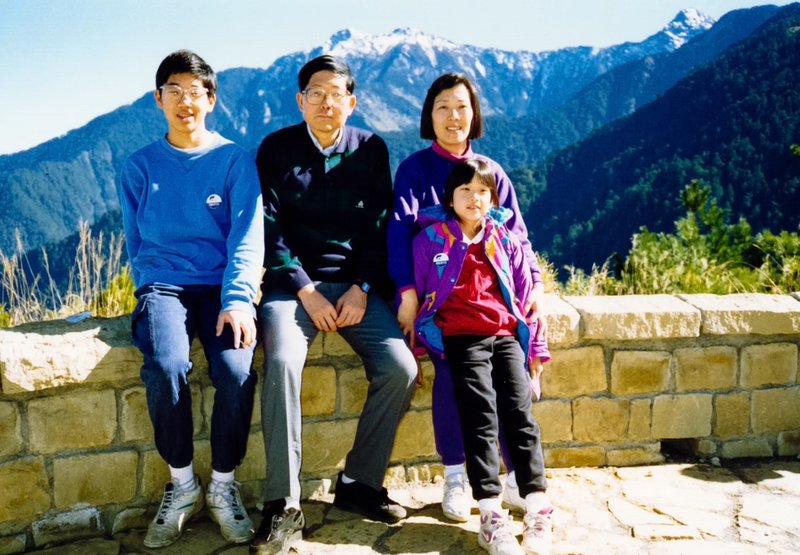
Yuk and Shau May Yung with their children.
A Seat at the Table for Everyone
In the mid-1980s, there was always a seat at the Thanksgiving table for Jason Wen (MS '85), and he was grateful for it. His first two years in the United States were difficult, he says, and he found comfort being surrounded by others who were also adapting to a new country.
Wen and fellow students founded the Caltech C in 1985 and invited Yung to serve as faculty adviser to turn this informal network into something more official. They kept in touch over the years, but it was the Caltech C that reunited the mentor and student for the last time: Yung spoke at Caltech C’s 40th anniversary celebration this past October.
As soon as the Caltech C community learned of Yung’s passing, they looked for ways to honor their former adviser. When Wen learned that the Yung family was establishing a SURF fund, he contacted more than 500 Caltech C members worldwide. The group, which previously established the Caltech C Graduate Fellowship raised $125,000 in just three months. Wen is not surprised by the outpouring of donations.
"Dr. Yung not only showed me and other Chinese students how to be researchers but how to live life in the United States," Wen says. "At that time, nobody offered that kind of assistance. He really impacted our lives."