Graduate Fellowships
Testing Economic Theories to Build a Better World
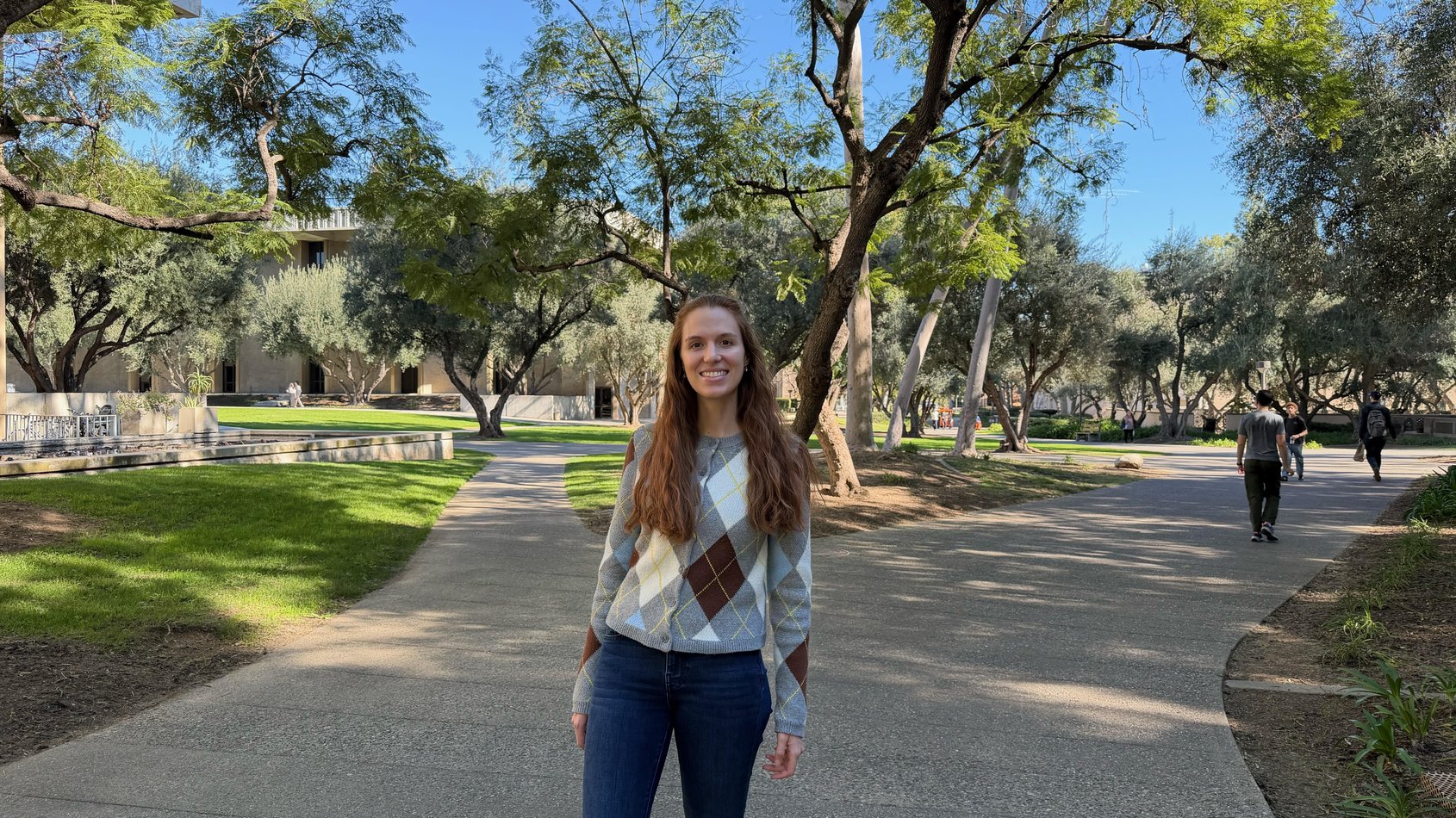
Humanities and Social Sciences fellowship recipient challenges a "one-size-fits-all" approach through behavioral economics.
For Camila Farrés, a doctoral fellowship is much more than a source of funding for her education. The James and Karen Gerard Fellowship in Social Sciences allowed her to pursue research she hopes will one day address a topic that is personal to her—alleviating poverty.
Farrés was born in Mexico and her family moved to Venezuela when she was three. They lived on the outskirts of Caracas and opened a school in an area with scarce resources. There she saw firsthand the impact of economic crises and political turmoil on her friends and their families.
"There were such stark contrasts between rich and poor," she says. "I thought 'How is it possible this problem still exists?'"
At first, she considered philosophy as a lens for viewing the problem. After high school, she moved to Berlin and studied German so she could read the original texts of their philosophers. However, as she traveled throughout Europe, exposure to different countries and their policies solidified her choice to study economics.
Her bachelor's degree led to a master's, where her advisor recommended the PhD program in Caltech's Division of the Humanities and Social Sciences. "I loved economic theory and I wanted the opportunity to test them and to create my own," says Farrés. "My advisor told me Caltech was the best place to do that.
"When I read the description of Caltech's program, it was love at first sight. I thought 'This is my place. This is where I want to go.'"
An Early Challenge to a Promising Academic Career
The journey that would eventually lead Farrés to Caltech was not without its challenges.
At 19 she was diagnosed with cancer she spent a decade fighting. Her symptoms began within a week of starting her bachelor's in economics at Instituto Tecnológico Autónomo de México (ITAM). The sweating and itchiness seemed so unremarkable at first that it took a year for the diagnosis: Hodgkin lymphoma.
"My reaction was 'I don't want cancer to become the center of my life,'" says Farrés. "If I die, I'll die doing want I want to do: learning."
She waited until final exams were over to begin chemotherapy. "My life became school during the week and chemotherapy on the weekends," she says. "I had my student life and my sick life."
By balancing dedication to school and aggressive chemotherapy and radiation, she only delayed her graduation two semesters.
Years later, Farrés was staying with her family when she received the acceptance from Caltech. "I went to my room, opened my email, and just started crying, because Caltech was my dream school," she recalls. "I am grateful for the fellowship that was awarded to me. It's been incredibly helpful in allowing me to focus on my research."
Finding a Cooperative Research Community
Now a fourth-year social science doctoral student, Farrés has found an atmosphere that's purpose-driven and collegial rather than competitive. "We don't do research to publish in a journal, to do better than others, or to have another line in our CVs," she says. "We do research to understand the world better, and by understanding the world, make it a better place."
One collaborative Caltech event that stands out for her showcased Hertz Fellows from different departments. "There were students researching stars that collided billions of years ago and measuring the bones of dinosaurs to determine what they ate," she says. "You could really see how everyone here cares so much about understanding the world."
Farrés has also found herself embraced by supportive professors. "The faculty really commit to the students here at Caltech," she says. "All of them are so open to talking to you. You have all of the institution behind you, helping you and pushing you to be a researcher."
That's especially true of her advisor, Charles Sprenger, the William D. Hacker Professor of Economics. "I get to work with him side by side," she says. "For a paper we're working on, we started with a question together, did the design together, and we're doing the analysis together. He takes my hurricane of ideas, strips it down to the essential core, and guides me through it step by step."
Sprenger has also involved her in a long-term, interdisciplinary project with Professor of Economics Kota Saito. Farrés is helping design experiments that use Sprenger's experimental tools for measuring time preferences (such as procrastination vs. proactivity) to predict mental health diseases, including attention-deficit hyperactivity disorder, obsessive-compulsive disorder, and depression in Japan.
Taking a Personal Approach to Poverty
Her own research is focused on decision-making and how economic policy can be made more effective by personalizing it to the individual. Farrés believes that while understanding macroeconomics is important, designing support at a granular level can be more effective than a one-size-fits-all approach.
Everyone has different needs, she argues. To do that, she is testing models that assess people's thinking about risk as they make decisions that could raise them out of poverty.
"In the future, I hope I can work with people in other fields, government, institutions, and companies in locations where we can actually be effective," says Farrés. "How can we use the tools we develop in the lab to measure unobservable characteristics—like preferences and beliefs—to personalize policies that could hopefully help us build a better world?"